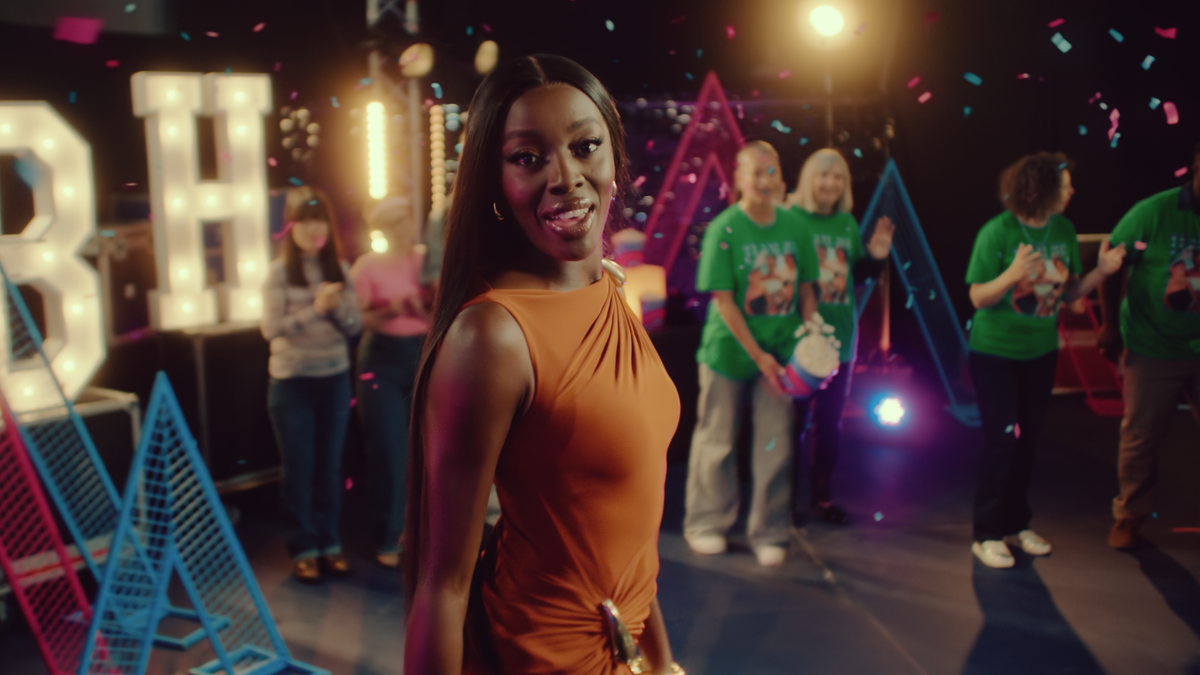
In partnership with Benenden Health and ITV, we produced a suite of three commercials positioning Benenden as the smart, cost-effective health solution for modern businesses.
Director: Simon Willows
Prod. Company: ITV
Agency: ITV
Client: Benenden
Each film tackles a distinct angle: the peace of mind that comes from knowing your family is covered; the business case for supporting employee wellbeing, reducing absence, and strengthening benefits packages; and the everyday health concerns that quietly disrupt the things that matter most.
All three share a unifying visual device — time freezes as the narrator moves through the scene, giving each story a calm, considered quality that mirrors the reassurance Benenden offers.
Entertainment
The central challenge was the frozen ticker tape — how to suspend it convincingly in mid-air while keeping the whole frame feeling alive rather than simply paused.
The approach combined a practical and post technique: talent performed the freeze on set, with any residual movement locked off in post. CGI then took over to populate the environment and selectively stop time with the right texture and credibility.
Simple on screen, complex underneath. The biggest technical lift was choreographing believable contact between the talent and the CG elements — particularly the moment she moves through the ticker tape cloud and connects with the button. Characters had to be repositioned to make those interactions read as natural, which meant finding precisely the right energy and velocity for the freeze itself.
The ticker tape distribution needed its own careful calibration. Too chaotic and it becomes noise; too orderly and it loses its spontaneity. The goal was a semi-suspended state — readable, plausible, but still carrying the feeling of a moment genuinely stopped in time. And crucially, as the narrator passes through it, the tape had to respond — displaced, disturbed, reacting to her presence — rather than simply existing around her.
Drama
The drama film follows the same structural logic, with the frozen balloon standing in for the ticker tape as the central visual device.
With balloons filling the background, the challenge was legibility — ensuring the audience could absorb and register the key moment without confusion. The solution was the shockwave: a ripple that radiates outward from the pain point, giving the freeze a physical cause and effect that the eye can follow instinctively. It does the work of directing attention while adding a layer of visceral impact that makes the stop-in-time feel earned rather than arbitrary.
Daytime
The execution was more complex than it first appeared. The editor selected two entirely different takes — one for the TV screen, another for the moment the camera pushes through into the real world — and the actresses' performances diverged slightly between them, particularly in their physicality and the timing of their movement.
That small mismatch created a fluid simulation problem: the food/fire dynamics had to feel coherent across both takes, even though they were shot separately and behaved differently. The solution meant tracking each shot independently, running two distinct simulations, and then engineering a seamless blend transition — ensuring both versions landed in the same physical state at the precise moment the camera crosses from screen to world.
As usual, working with Simon Willows was a pleasure because he goes to the shoot super prepared and therefore there was very little left to chance.
The link has been copied!
Your link has expired. Please request a new one.
Your link has expired. Please request a new one.
Your link has expired. Please request a new one.
Great! You've successfully signed up.
Great! You've successfully signed up.
Welcome back! You've successfully signed in.
Success! You now have access to additional content.